
RV Training in Arizona
Customized RV Training for Personal Owners and Businesses. Bring Your Own Vehicle.
Driving a large recreational vehicle is different from driving a standard passenger car. The size, weight, braking distance, hooking up (or coupling), and clearance demands of an RV require a specific set of skills that most drivers have never been formally taught.
Southwest Truck Driver Training offers customized RV training at campuses in Phoenix and Tucson, Arizona. The program is entirely hands-on and built around the student’s actual vehicle and goals. No commercial license is required. Students bring their own vehicle and work one-on-one with an experienced instructor.
Programs are available for personal RV owners, drivers upgrading to a larger or more complex vehicle, and businesses that operate RVs as part of their work. Training hours are flexible and scheduled around the student’s or company’s availability.
Graduates receive a Southwest Recreational Vehicle Training Certificate of Attendance, which many insurance companies recognize and may use to offer a rate reduction.
Program at a Glance
| Format | Primarily Hands-on, behind-the-wheel training (no classroom component) |
| Vehicle | Bring Your Own RV (BYORV) |
| License Required | Standard Class D driver’s license |
| Duration | Flexible: 4 hours, 8 hours, or customized to the student’s or company’s goals. Completed in one or more sessions |
| Scheduling | One-on-one custom schedule for the student or company’s needs |
| Campuses | Phoenix and Tucson, Arizona |
| Certificate | Southwest Recreational Vehicle Training Certificate of Attendance |
| Tuition Assistance | RV Training does not currently offer tuition assistance options |
Who RV Training Is For?
Southwest’s RV training program is built to serve a wide range of students. The format is flexible by design because the reasons people need RV training are just as varied.
Personal RV Owners
Whether someone is new to RV ownership or has been driving for years, structured training builds the confidence and skill to handle their vehicle safely. The program is a strong fit for:
- First-time RV owners getting comfortable before their first trip
- Retirees preparing for seasonal travel
- Drivers who have upgraded to a larger or more complex vehicle
- Anyone transitioning from a bumper tow setup to a Class A motorhome with a towable
- Drivers who want to sharpen specific skills, such as backing, tight-space maneuvering, or highway driving
- Second-seat drivers who are usually not the primary driver, who want to build their skills in case they need or want to drive
Businesses and Organizations
Southwest also provides RV training for municipalities, companies, and organizations that operate recreational or specialty vehicles as part of their work. This includes:
- Mobile libraries and bookmobiles
- Mobile medical units, blood donation vehicles, and health screening facilities
- Mobile marketing and brand activation vehicles
- Any organization operating a large mobile unit that functions as a traveling version of a traditional facility
Business clients work directly with Southwest to build a training plan around their vehicle type, staff, and operational requirements. The same standard of instruction that Southwest has applied to CDL training for over 25 years applies to every business RV training engagement.
Learn more about Southwest’s Business Development program
Training Built Around the Student, Not a Standard Curriculum
No two RV training students have the same starting point or the same goals. Southwest does not offer a one-size-fits-all program.
Training hours are fully customizable. A student who needs a focused four-hour refresher on backing and parking gets exactly that. A student who wants a comprehensive eight-hour day covering every major skill area can have that instead. A business that needs 20 hours of training for a team of employees gets a plan built around that scope.
Topics covered can include any combination of the following, based on what the student actually needs:
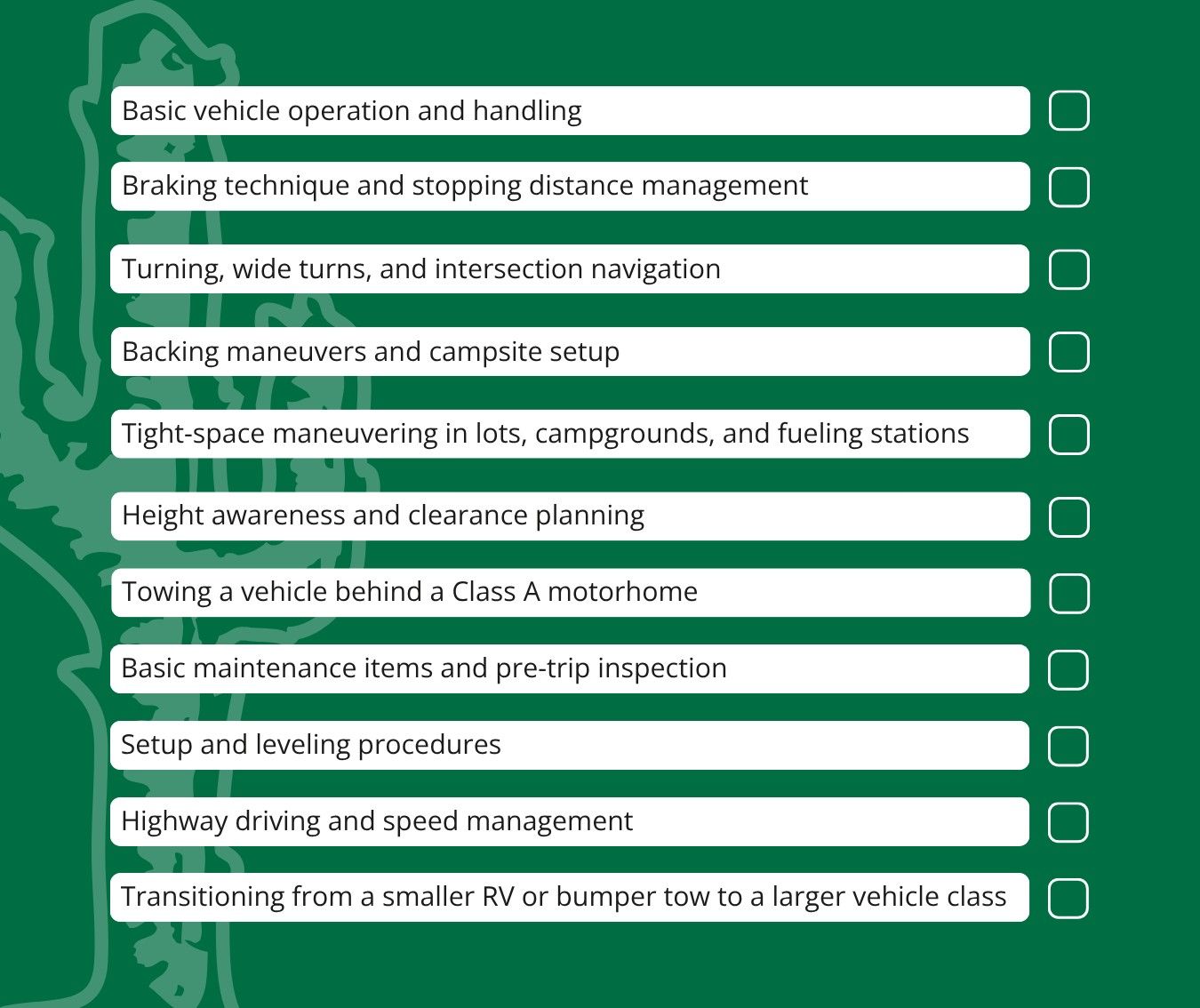
Students unsure of what they need can discuss their situation with our team before enrolling. The team will help identify the right scope of training for their vehicle and goals.
Bring Your Own RV (BYORV)
Southwest’s RV training is a Bring Your Own RV program. Students train with the actual vehicle they own or operate. This approach is intentional.
Every RV handles differently. A student who trains in their own vehicle leaves the program knowing exactly how that vehicle responds on the road, in tight spaces, and under braking. The skills transfer directly to real-world operation from day one.
There are no restrictions on vehicle class or size. Students should ensure their RV is in roadworthy condition before arriving for training.
Core Skills Covered in RV Training
While the program is customizable, the following areas form the foundation of most RV training sessions. Each is covered with the student’s own vehicle on real roads and in real driving conditions.
Handling
Large recreational vehicles respond differently than standard passenger vehicles. Training covers how to manage the weight, momentum, and body roll specific to RVs so students understand how the vehicle behaves before encountering challenging conditions.
Tight Spaces
Campgrounds, fuel stations, parking lots, and urban streets often require precise maneuvering in confined areas. Students practice navigating tight quarters in their own vehicles until they can do so with confidence.
Braking
An RV’s stopping distance is significantly longer than a car’s. Training covers proper braking technique, distance management, and responding when road or weather conditions change. This is one of the most common areas where RV drivers are underprepared.
Turning and Backing
Wide turns and backing maneuvers are among the most challenging aspects of RV operation. The program gives students structured practice with both, including backing into campsites and navigating intersections without cutting turns too tight.
Height Limitations
Many RV drivers underestimate clearance requirements. Training covers how to identify vehicle height, read clearance signage, plan routes around low bridges and overhangs, and avoid costly and dangerous clearance errors.
Maintenance and Setup
Students who want to go beyond driving can include basic maintenance awareness and setup procedures in their training. This covers pre-trip inspection items, leveling, and the operational basics every RV owner should know before heading out.
Southwest RV Training Certificate of Attendance
Every student who completes the RV training program receives a Southwest Recreational Vehicle Training Certificate of Attendance. This certificate documents that the student completed hands-on training with experienced instructors at a recognized Arizona training school.
Many insurance companies recognize this certificate and may apply it toward a rate reduction. Students are encouraged to contact their insurer before or after enrollment to ask about any applicable discounts for completing a formal RV training course.
Southwest Truck Driver Training has been operating as a state-recognized training school since 1999. The certificate reflects that credibility.
RV Training at Our Phoenix and Tucson Campuses
Southwest Truck Driver Training offers RV training at both Arizona campuses. Students can enroll at whichever campus is most convenient.

Visit Us
1230 W Glenn St,
Tucson, AZ 85705

Visit Us
2323 51st Ave
Phoenix, AZ 85043
Ready to Get Started?
Personal owners, first-time drivers, and business clients are all welcome. Contact our team to discuss the right training plan for the vehicle and goals at hand.
Frequently Asked Questions About RV Training
Do I need a special license to take the RV training program?
No. A standard Class D driver’s license is all that is required. No commercial driver’s license or special permit is needed to operate a personal recreational vehicle in Arizona.
Do I bring my own RV to training?
Yes. Southwest’s RV training is a Bring Your Own RV (BYORV) program. Students train with the vehicle they own or operate, whether that is a Class A motorhome, a bumper tow setup, or a large specialty vehicle.
How long is the RV training program?
The program is flexible. Options include a 4-hour session, an 8-hour session, or a fully customized training plan built around their goals. Sessions are completed in a single day or spread across multiple days, depending on the selected training scope.
Is there a written or classroom portion of RV training?
Standard RV training is hands-on and behind the wheel. That said, Southwest can build a classroom or knowledge component into the program for students or business clients who want one.
Do businesses and organizations qualify for RV training?
Yes. Southwest provides RV training for municipalities, companies, and organizations that operate large vehicles as part of their work. This includes mobile libraries, medical units, company housing vehicles, and similar operations. Business clients work directly with Southwest to build a training plan around their needs.
Is there a minimum age requirement?
There is no formal minimum age requirement to drive a personal RV. However, most rental companies require drivers to be between 21 and 25 years of age. Students planning to rent an RV should confirm requirements with their rental provider before enrolling.
Is tuition assistance available for RV training?
No. SWTDT does not offer tuition assistance for the RV training program at this time.