Leaving Davis-Monthan? What a Trucking Career in Tucson Actually Takes
You’re 300 days from your separation date, sitting in a Transition Assistance Program (TAP) briefing at Davis-Monthan Air Force Base (DM AFB). Somebody just handed you a folder of pamphlets about resume templates. None of them tell you what to actually do with your hands. If you spent your enlistment loading pallets, running convoy security, or keeping aircraft parts moving on schedule, there’s a civilian career that uses exactly that muscle memory: driving a truck. Here’s what the transition from DM AFB to a CDL actually looks like, without the recruiting-brochure gloss. Some of the people who’d walk you through it have sat in that same TAP briefing themselves.
Your Transition Window Is Longer Than It Feels Right Now
The Department of Defense requires TAP counseling to start no later than 365 days before you separate or retire. If you’re retiring rather than separating, the recommendation is to begin as early as 24 months out. That window exists so you’re not scrambling in your last 30 days trying to figure out what comes next. Use it.
Davis-Monthan’s Own Transition Programs
Davis-Monthan already runs programs built for exactly this problem. The Desert Thunder Squadron’s “One Year Away” initiative works with airmen inside that final year before they leave. It’s not small: roughly 600 to 800 airmen retire from active duty at DM AFB every year. The base has partnered with Edge4Vets, a program out of Fordham University’s Human Resiliency Institute. Edge4Vets has already helped more than 3,000 veterans nationwide translate their service into a civilian career plan, and it ran a pilot with 75 airmen in 2025 that’s expanding in 2026. If you haven’t talked to your TAP counselor or the base Education Center about what’s available, that’s the first call to make. Do that well before you touch a CDL application.
Using Terminal Leave Before Your DD214 Lands
Terminal leave matters here too. Many separating service members use that leave block to start civilian training before their official separation date. That way, they don’t have to wait for the DD214 to land in their hands. If a CDL program fits into that window, you can walk off base and move almost straight into a driver’s seat. That beats sitting through a job search with no income and no plan. Before you commit to a school, it’s worth knowing what Arizona actually requires for a CDL, from the age minimums to the permit process.
What Your Service Already Taught You, Translated Into Trucking Terms
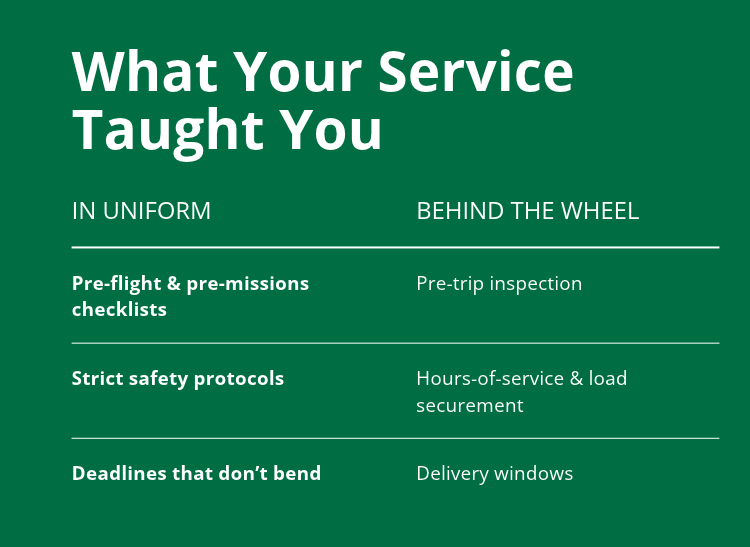
Nobody hands you a truck because you served. But a lot of what the job actually rewards, you already have. You’ve run pre-flight or pre-mission checklists with zero tolerance for skipping a step. That’s a pre-trip inspection. You’ve worked inside strict safety protocols where a missed procedure has real consequences. That’s how the industry treats hours-of-service rules and load securement. You’ve managed schedules and deadlines that didn’t bend just because you were tired. That’s a delivery window.
None of that requires your Air Force Specialty Code to have anything to do with transportation. Logistics, maintenance, supply, security forces. None of it matters. What matters is that you already operate inside a system built on precision and accountability. That’s the exact profile trucking companies are trying to hire. It’s also the profile a lot of our own instructors came from. Several made this same jump from a uniform to a CDL, so they’re not guessing at how the translation works.
The Career Math, Straight
The career itself holds up under scrutiny, too. The Bureau of Labor Statistics puts the 2025 median pay for heavy and tractor-trailer truck drivers at $58,640 a year. Employment is projected to grow 4% from 2025 to 2035, with roughly 214,500 openings a year nationally as the current workforce retires or moves on. That’s not a boom, and nobody should tell you it is. It’s a steady, in-demand trade with a real wage floor, which is a fair trade for the discipline you already built. That wage floor holds up across the different types of driving jobs graduates take on, whether that’s local, regional, or over-the-road.
Paying for Training Without the Paperwork Eating Your First Month Home
Your GI Bill benefits, both Post-9/11 and Montgomery, cover non-college degree programs. CDL training is explicitly one of them, right alongside HVAC and EMT training. The catch is that the school has to be VA-approved. Not every CDL program is, so confirm approval status before you sign anything. The VA also recently implemented part of the Dole Act, which speeds up how new CDL training locations get approved for GI Bill students. That cuts some of the red tape that used to slow schools down. If you’re a military spouse rather than the service member, MyCAA may be worth a look for the same kind of training.
Southwest Truck Driver Training works with students on this directly. That includes a $500 discount for veterans, and our Director of Veteran Affairs, who served before taking on that role, can walk you through what your specific veteran benefit covers before you enroll. Verify your own numbers with VA.gov and the GI Bill Comparison Tool too. Nobody should be guessing about their own benefits, and we’d rather you ask twice than assume once. You can also see the full range of ways to pay for training if the GI Bill doesn’t cover everything.
What Veteran Support Looks Like on Our Tucson Campus
Southwest Truck Driver Training has been family-owned since 1999, when Gary P. Williams, a working truck driver, started the school with a handful of family and friends. His sons run it today, and one of them is a military veteran himself. A good number of our instructors and staff, including our Director of Veteran Affairs, are veterans too. That means the people teaching you, and the people you’ll deal with outside the classroom, already understand what it means to operate inside a chain of command and then have to build a civilian one from scratch.
That’s not just a talking point. SWTDT is affiliated with the Commercial Vehicle Training Association, Truckers Against Trafficking, and the Arizona Private School Association. Our president has represented veteran CDL training funding in front of federal lawmakers in Washington, D.C. We’re not new to this conversation, and we’re not doing it for a marketing badge.
Training on the Ground in Tucson
On the ground at our Tucson campus, that support looks like practical things. Our Class A CDL program runs 160 hours, split evenly between classroom and behind-the-wheel time. Class B students get that same depth of training rather than a shortened version. Day, evening, and weekend schedule tracks exist specifically so training can fit around terminal leave, a part-time job, or family obligations while you’re still figuring out your footing. Both automatic and manual transmission trucks are part of the fleet. Skills testing happens on campus, on the same range where you trained, so you’re not driving across town to test on equipment you’ve never touched.
Why a Family-Owned School Fits Someone Leaving a Structured System
You’re coming out of an organization where rank, structure, and accountability meant something. A corporate CDL chain, run by a regional office you’ll never meet, isn’t built to replace that. A family-owned school can be.
At SWTDT, the instructor who teaches your pre-trip inspection in week one is the same one grading your skills test in week four. Class sizes stay small enough that instructors know students by name, not by enrollment number. If something’s not working for you, the people who can actually fix it are on campus, not three states away in a call center. That’s the whole point of the philosophy posted at both our campuses: the student is the most important person here, not a statistic.
An Honest Note on Trade-Offs
That doesn’t mean trucking is without trade-offs. Over-the-road driving means real time away from home, so weigh that honestly against your family situation before you commit to a route type. Plenty of our graduates start regional or local instead of long-haul to stay closer to home while they build experience, then make changes once they know what fits.
Whatever you decide, don’t wait until your DD214 is signed to start figuring it out. The window is open now, and it’s longer than the pamphlets make it feel.
Ready to take the first step? Talk to our team today.