Manual Transmission Training Gives Tucson and Phoenix Drivers More Job Options
The Automatic Restriction Few New Drivers Expect
A CDL skills test taken in an automatic truck comes with a quiet catch. The state adds a restriction to the license. That restriction blocks the driver from operating any truck built with a manual transmission. Many new drivers don’t find out until later. A dispatcher or hiring manager turns them down for a job they were otherwise qualified for. The truck in the yard has a clutch and a stick, and the license shows they have never trained on one.
This is not a rare story. Truck driving schools across the country have shifted toward automatic-only fleets. Automatics cost less to maintain and take less time to teach. Trucking forums and CDL school reviews echo the same complaint. Schools skip manual training. Students find out later how many trucks, and how many jobs, that choice closes off.
Southwest Truck Driver Training Trains Students on Manual, Too
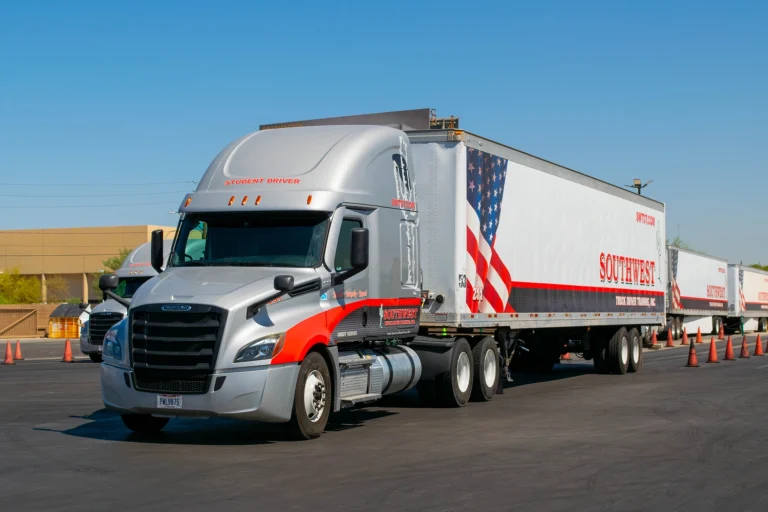
Southwest Truck Driver Training’s Class A and Class B students train on a late-model fleet at both the Phoenix and Tucson campuses. That fleet includes both automatic and manual transmission trucks. This is not a leftover from an older curriculum. It is a deliberate choice at every SWTDT location. A driver who can run both types of equipment can say yes to more jobs than a driver who can run only one. Most schools in the area do not say much either way about which transmissions their students actually train on.
For someone who has never driven anything bigger than a pickup truck, shifting gears by hand can sound like the hardest part. It usually is not. It is a physical skill built through repetition with an instructor to walk you through it. That kind of hands-on training has shaped SWTDT’s programs since 1999. It is also why manual transmission training has stayed in the curriculum instead of getting phased out for convenience.

Why Tucson’s Freight Corridor Makes This Matter More
Both Phoenix and Tucson sit on the I-10 corridor, one of the busiest east-west freight routes in the country. Phoenix has become one of the Southwest’s largest distribution hubs, with major carriers and warehouses lining I-10 and I-17. Tucson’s freight profile looks different. The city sits closer to the U.S.-Mexico border, and cross-border freight makes up a bigger share of daily traffic here than it does farther north. The Port of Tucson adds another layer specific to this market. It is an inland rail and logistics hub that transfers freight between trains and trucks on the city’s east side. Together, these factors help logistics and warehousing account for roughly 8 percent of employment in the Tucson area, according to regional economic data.
Freight moving through a corridor like this does not run on one uniform fleet of new automatics. Drayage runs between the border and inland distribution points. Transfer work happens at rail-truck hubs like the Port of Tucson. Regional and local carrier fleets often hold onto older or specialized equipment longer than long-haul operations do. Manual transmissions are frequently part of that older equipment. A driver who can only run automatic has a shorter list of trucks and employers willing to hire them. A driver who can run both does not face that ceiling.
Students training at the Phoenix campus get the same manual transmission instruction. Phoenix’s freight networks also mix older regional equipment in with modern long-haul fleets. Tucson’s border-adjacent, rail-connected corridor just makes the case especially direct. Manual transmission skills open doors here that automatic-only training closes.
Ready When Students Are
No trucking background is required to start. All you need is a valid driver’s license and the willingness to learn a skill fewer new drivers bother picking up anymore. That skill is exactly what will matter most when a Tucson employer who still runs manual rigs is deciding who to hire.
Ready to take the first step? Talk to our team today.